

Summary: Casino games 2026 span simple slots, strategic blackjack, classic roulette, social craps, baccarat, video poker, poker, live dealer formats, crash games, keno, and bingo. The right choice depends on your preferred pace, skill level, volatility, odds, availability, and budget. Compare the specific rules and RTP before playing, because the same category can vary significantly by version and operator.
The right casino game is not necessarily the one with the biggest jackpot or the lowest house edge. It should match your preferred pace, decision-making style, budget, and comfort with variance. If variety and straightforward entertainment matter most, our online casino slots provide a useful starting point for exploring different themes, mechanics, and volatility levels.
Casino games 2026 also differ by location and format. Some titles are common in land-based casinos, while others are mainly found online or through live dealer studios. Availability can depend on local rules, operator licensing, and the specific platform. For a broader view of regulated gaming markets, consult this state gaming map before making assumptions about access.
Casino games 2026 at a glance
There is no universal best casino game. The strongest choice depends on what you value, such as simple rules, strategic decisions, social interaction, fast rounds, or a lower theoretical house edge. The table below provides a practical starting point before the detailed explanations.
| No. | Game | Best for | Key difference |
|---|---|---|---|
| 1 | Slot games | Variety and easy play | Large selection of themes and mechanics |
| 2 | Blackjack | Strategy-focused players | Decisions can materially affect the house edge |
| 3 | Roulette | Simple, classic gameplay | Wheel type changes the mathematical edge |
| 4 | Craps | Social table action | Several bets have very different odds |
| 5 | Baccarat | Simple card play | Few decisions after the initial wager |
| 6 | Video poker | Machine play with strategy | Paytables and decisions determine value |
| 8 | Live casino games | Real dealer atmosphere | Streaming combines online access with physical tables |
| 7 | Poker | Competing against other players | The casino earns a rake rather than beating you directly |
| 9 | Crash games | Fast sessions | You choose when to cash out before the multiplier stops |
| 10 | Keno | Low-interaction play | Number selection with highly variable payouts |
| 11 | Bingo | Relaxed and social play | Rules, patterns, and prizes vary by version |
How to compare casino games before playing
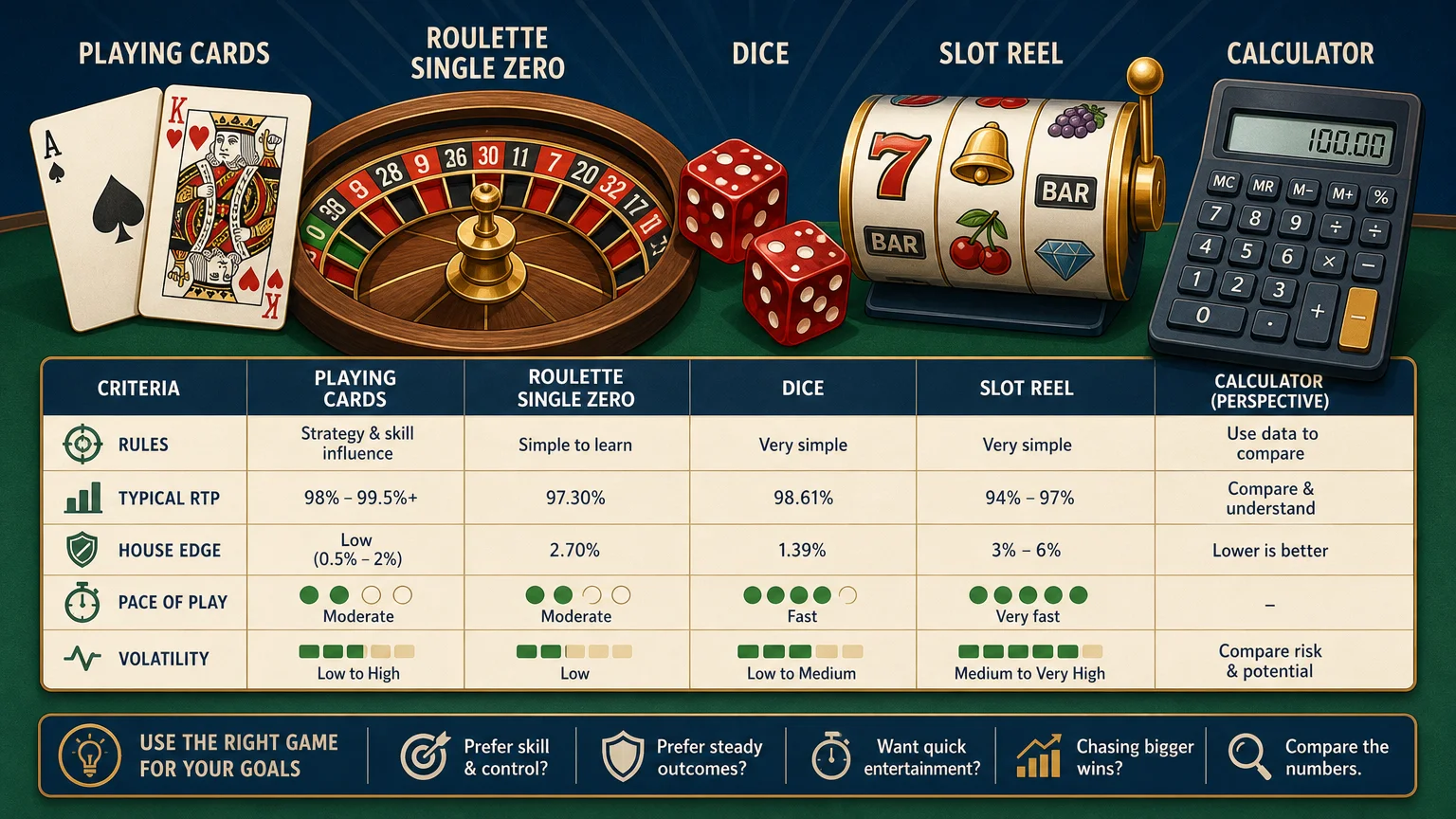
Before choosing a game, separate entertainment preferences from mathematical considerations. RTP, or Return to Player, describes the theoretical percentage returned over a very large number of plays. The house edge expresses the same relationship from the casino’s perspective. Neither figure predicts the result of one session.
Rules matter as much as the game name. A single-zero roulette wheel is materially different from an American double-zero wheel. A blackjack table paying 3:2 on a natural hand is different from one paying 6:5. A video poker title with a strong paytable can differ substantially from an otherwise similar title with reduced payouts.
For a useful reference on standard mathematical comparisons, review this house edge reference. Treat the figures as long-term estimates, and check the exact rules, paytable, RTP, minimum stake, and maximum stake on the platform you are considering.
Match the format to your priorities
Your priorities can narrow the selection quickly. Players seeking simple entertainment may prefer slots, roulette, bingo, or keno. Those who want decisions to influence the mathematics may prefer blackjack or video poker. Players seeking a social environment may enjoy craps, poker, or live dealer tables.
Volatility and pace deserve equal attention. High-volatility games can produce larger but less frequent wins, while lower-volatility formats may produce smaller outcomes more regularly. Fast games also require stronger time and spending limits because more rounds can be completed within a short session.
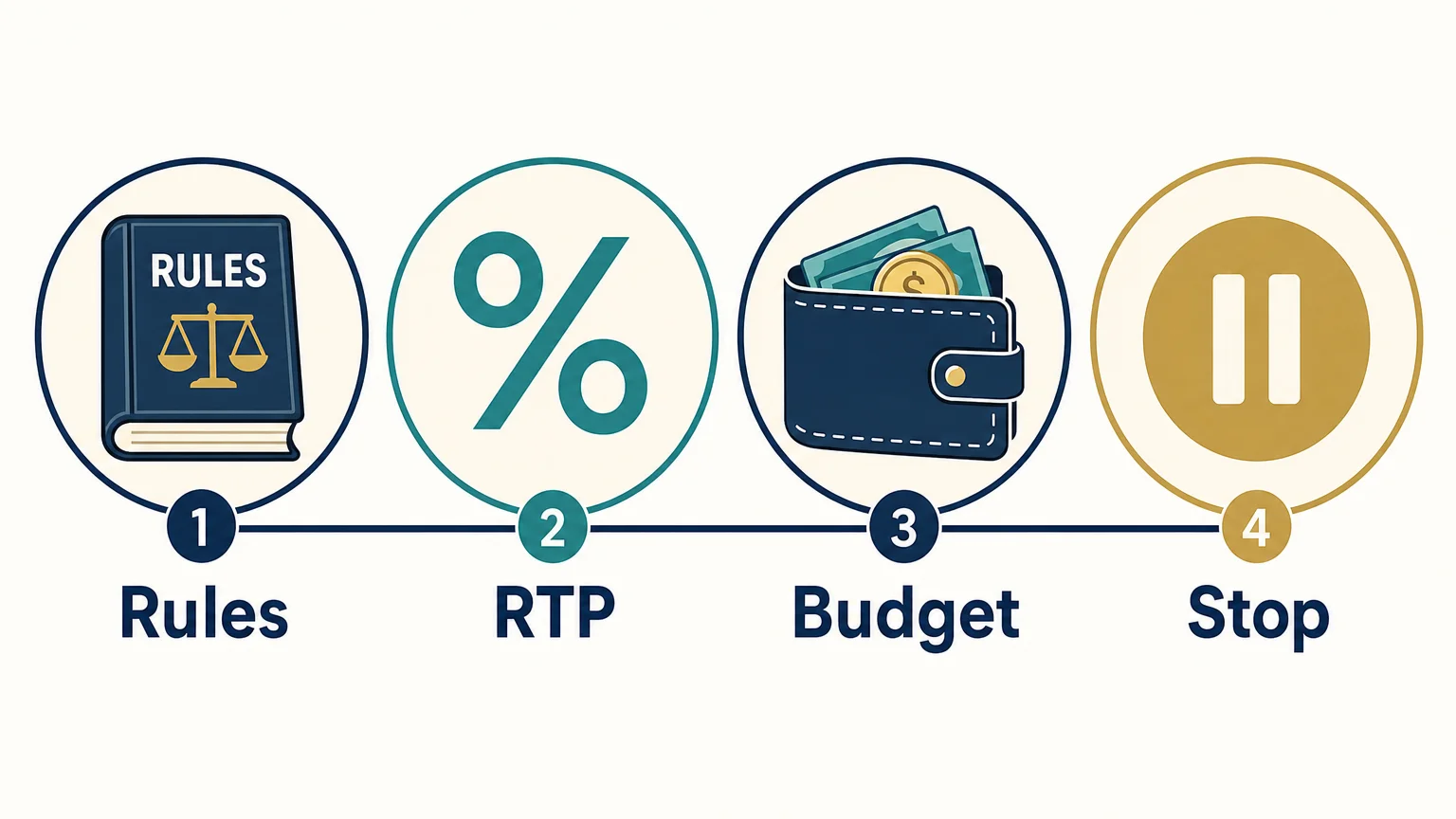
A practical approach is to begin in demo mode where available, read the rules, identify the relevant RTP or house edge, and set a fixed entertainment budget. No selection removes financial risk, and no betting system changes the underlying mathematics of a chance-based game.
1. Slot games
Best for: Players who want immediate gameplay, broad theme selection, flexible stakes, and no complex rules.
Slot games remain the most accessible casino format. You select a stake, spin the reels, and wait for matching symbols, feature triggers, or jackpot combinations. Modern titles may use cascading wins, expanding wilds, free spins, bonus rounds, progressive jackpots, or feature-buy options.
RTP varies by title and configuration, while volatility describes how frequently wins may occur and how large they may be. A high RTP does not guarantee a winning session, particularly when the game also carries high volatility. Players should review both figures before choosing a title.
Pros:
Simple rules and minimal learning time.
Wide variety of themes, mechanics, and stake levels.
Commonly available on desktop and mobile devices.
Cons:
Outcomes are determined by chance, with no player decision affecting individual spins.
High-volatility titles can produce long periods without significant wins.
Jackpot features may come with particularly low winning probabilities.
2. Blackjack
Best for: Players who want a traditional card game where strategy and rule selection can influence the theoretical house edge.
Blackjack aims to beat the dealer by reaching a hand value closer to 21 without exceeding it. Players can usually hit, stand, double down, or split pairs. The correct decision depends on the player’s hand and the dealer’s visible card, which makes basic strategy valuable.
Under favorable rules and accurate basic strategy, the house edge can be close to 0.5 percent. The exact figure depends on the number of decks, blackjack payout, dealer rules, doubling restrictions, surrender options, and side bets. Our online blackjack coverage can help you review the format and common rule differences.
Pros:
Player decisions can reduce the theoretical house advantage.
Rounds are usually quick and easy to follow.
Available in digital, live dealer, and land-based formats.
Cons:
Incorrect decisions increase the expected cost of play.
Rule variations can make similar-looking tables materially different.
Side bets often carry a much higher house edge than the main wager.
3. Roulette
Best for: Players who prefer simple rules, visual excitement, and a choice between many betting patterns.
Roulette requires you to predict where a ball will land on a numbered wheel. You may choose a single number, a group of numbers, a color, an odd or even result, or another outside combination. The simplicity makes roulette easy to learn, but the wheel variant is crucial.
European roulette has one zero and a standard house edge of 2.7 percent. American roulette has both 0 and 00, increasing the standard edge to 5.26 percent. French roulette with La Partage can reduce the edge on qualifying even-money bets to approximately 1.35 percent. Our online roulette resources provide a useful starting point for comparing these formats.
Pros:
Very easy to understand without prior experience.
Offers many bet sizes and risk profiles.
Works well in live dealer, digital, and land-based settings.
Cons:
No betting system changes the wheel’s mathematical edge.
American roulette is less favorable than single-zero variants.
Inside bets can produce large payouts but win infrequently.
4. Craps
Best for: Players who enjoy energetic table action, shared outcomes, and a broad range of betting choices.
Craps centers on the roll of two dice. The Pass Line bet is the usual starting point, while players can later add Come, Don’t Pass, Place, Field, and proposition bets. The table may appear complicated, but beginners can participate with only a basic understanding of the Pass Line.
The Pass Line house edge is about 1.41 percent, while Don’t Pass is about 1.36 percent under standard rules. Odds bets pay true mathematical odds and carry no house edge by themselves, although the required base bet still matters. Proposition bets can be far less favorable, so learning the difference is essential.
Pros:
Strong social atmosphere around the table.
Some core bets offer comparatively favorable mathematics.
Players can gradually learn additional options.
Cons:
The layout and terminology can intimidate new players.
Many proposition bets have a substantially higher house edge.
The pace and table etiquette may feel demanding at first.
5. Baccarat
Best for: Players who want simple card wagering with very few decisions after the initial bet.
In baccarat, you normally bet on the Player hand, Banker hand, or Tie. Cards are dealt according to fixed rules, and the hand closest to nine wins. You do not decide whether cards should be drawn, so the learning curve is low.
Under conventional rules, the Banker bet carries a house edge of approximately 1.06 percent, while the Player bet is about 1.24 percent. The Tie bet usually has a much higher edge. Online baccarat may also include commission-free variations, so you should check the exact payout structure before playing.
Pros:
Simple rules and minimal decision-making.
Banker and Player bets can offer relatively low house edges.
Available in digital, live dealer, and high-limit environments.
Cons:
The Tie bet is generally much less favorable.
Players have little control over the actual hand decisions.
Commission and payout rules vary between versions.
6. Video poker
Best for: Players who want machine-based play with meaningful decisions and transparent paytables.
Video poker combines a five-card poker hand with a machine format. You receive cards, choose which to hold, and receive replacements for the others. The final hand is compared with the displayed paytable, which determines the payout.
Paytable quality is critical. Full-pay versions of games such as Jacks or Better can offer RTP close to 99.5 percent when played with optimal strategy, while reduced-pay versions may be considerably less favorable. The displayed paytable should always be checked before you start.
Pros:
Player decisions directly affect expected results.
Paytables make the potential payouts visible.
Can suit players who prefer quiet, individual sessions.
Cons:
Optimal play requires learning strategy charts.
Reduced paytables can weaken the game substantially.
Short-term outcomes can still vary widely.
1. Live casino games
Best for: Players who want real dealers, physical cards or wheels, and a more social online experience.
Live casino games stream a dealer and table from a studio or casino environment. Players place wagers through an online interface while watching the action in real time. Common options include live blackjack, live roulette, baccarat, craps, and game-show formats.
The underlying mathematics usually comes from the specific game and rules, not from the live stream itself. For example, a live roulette table still depends on its wheel type, while live blackjack depends on blackjack payouts and dealer rules. Our live casino games section can help you compare the available formats.
Pros:
Provides a more immersive alternative to automated games.
Dealers and table procedures are visible in real time.
Often includes different limits and table styles.
Cons:
Streaming quality and table availability can vary.
Minimum stakes may be higher than automated versions.
Fast live formats can encourage repeated wagering.
2. Poker
Best for: Players who want to compete against other people and develop a skill-based approach.
Poker differs from house-banked casino games because the main opponent is another player rather than the casino. Texas Hold’em is the most familiar format, with private cards, community cards, several betting rounds, and opportunities to evaluate position, hand strength, and opponent behavior.
The casino or poker room generally earns a rake or tournament fee instead of setting a fixed house edge against every hand. Strong results require discipline, bankroll management, patience, and an understanding of probability. Short-term variance can remain substantial even for experienced players.
Pros:
Skill and decision-making can influence long-term performance.
Offers cash games, tournaments, and different table limits.
Creates a competitive social environment.
Cons:
The learning curve is steeper than most house-banked games.
Results depend on the strength and behavior of opponents.
Rake and tournament fees reduce the amount returned to players.
3. Crash games
Best for: Players who prefer rapid rounds and a clear cash-out decision.
Crash games usually display a multiplier that rises from a starting point before stopping unexpectedly. You place a wager and attempt to cash out before the round ends. If the multiplier stops first, the wager is lost. Some games include automatic cash-out settings or multiple simultaneous bets.
The crash point is random, so timing systems cannot reliably predict the next result. Some platforms publish RTP information or offer provably fair verification, but the exact mechanics vary by title. The speed makes strict session limits especially important.
Pros:
Rules can be understood within a few rounds.
Sessions are fast and available on many mobile platforms.
Cash-out timing creates an element of player choice.
Cons:
The rapid pace can lead to impulsive repeated bets.
A cash-out decision does not control when the round ends.
Availability, RTP, and verification features differ by game.
4. Keno
Best for: Players who want low-interaction number selection without strategic decisions during the draw.
Keno is a lottery-style game in which you select numbers and wait for a random draw. Payouts depend on how many chosen numbers match and on the specific paytable. The format is easy to play online or in some land-based venues.
The main comparison point is the paytable rather than a strategic decision. Keno can carry a high house edge, particularly when the payout structure is weak. You should review the prize schedule and treat the game as entertainment rather than an investment opportunity.
Pros:
Very simple rules and minimal learning time.
Suitable for relaxed sessions with little interaction.
Offers a range of number selections and payout levels.
Cons:
House edges can be high and vary by paytable.
No number pattern improves the next draw’s probability.
Large prizes are generally linked to difficult outcomes.
5. Bingo
Best for: Players who prefer relaxed, chance-based play with a social or community atmosphere.
Bingo uses cards or digital tickets containing numbers. A caller or automated system announces numbers, and players aim to complete a specified pattern. Different versions may use lines, corners, full houses, or special bonus patterns.
The experience depends heavily on the venue, number of participants, ticket cost, prize pool, and game speed. Online bingo can offer chat features and scheduled rooms, while land-based bingo often emphasizes social interaction. The exact odds and payouts should be checked for each session.
Pros:
Easy to understand and accessible to beginners.
Can provide a social experience through chat or shared rooms.
Offers varied patterns, schedules, and prize formats.
Cons:
Most outcomes are determined entirely by chance.
Prize structures vary considerably between rooms.
Multiple tickets can increase spending quickly.
Responsible play across casino games
Responsible play begins before you select a game. Set a spending limit, decide how long the session will last, and avoid increasing stakes to recover losses. Fast formats such as slots and crash games require particular attention because many rounds can occur within a short period.
Remember that RTP and house edge describe long-term mathematics, not a promise of profit. If gambling stops feeling entertaining, pause and use available deposit limits, cooling-off tools, or self-exclusion options. The National Council on Problem Gambling provides helpline information for people seeking support in the United States.
Conclusion
The best casino game is the one that matches your preferred level of choice, pace, social interaction, and financial risk. Slots and roulette offer simple chance-based play, blackjack and video poker reward careful decisions, while poker provides direct competition against other players. Before playing, compare the exact rules, RTP, paytable, volatility, availability, and responsible-gambling tools. A well-informed choice cannot remove risk, but it can make your expectations clearer and your session more controlled.
Take action with No Deposit Casinos
Choosing between casino games can be easier when the key terms are explained clearly. You may want to compare RTP, volatility, wagering mechanics, mobile compatibility, and the difference between automated, table, and live dealer formats before visiting an external operator.

We publish game reviews, category guides, and comparison content designed to help you evaluate these details more carefully. Our editorial approach includes game-focused analysis, terms-led explanations, and information about features that may affect the playing experience. Explore our casino game reviews and guides to continue your research, and always check the relevant terms and local rules before playing.
Frequently Asked Questions
Which casino game is easiest for beginners?
Slots, roulette, baccarat, and bingo are among the easiest games to learn because they require few decisions. You should still review the rules, payouts, and relevant limits before playing.
Which casino games offer the best theoretical odds?
Blackjack with favorable rules and accurate basic strategy, certain video poker paytables, baccarat Banker bets, and selected craps bets can offer comparatively low house edges. The exact result depends on the version, paytable, and your decisions.
Are online casino games available everywhere?
No. Availability depends on the laws, licensing framework, and operator permissions in your location. Always verify local rules before registering or wagering.
What is the difference between RTP and house edge?
RTP is the theoretical percentage a game returns to players over a very long period. House edge is the corresponding percentage the casino expects to retain, although neither figure predicts the result of one session.
How can you play casino games more responsibly?
Set a budget and time limit before playing, avoid chasing losses, and use deposit limits or self-exclusion tools when needed. Stop if gambling is no longer enjoyable or begins to affect your finances or wellbeing.